


Abstract
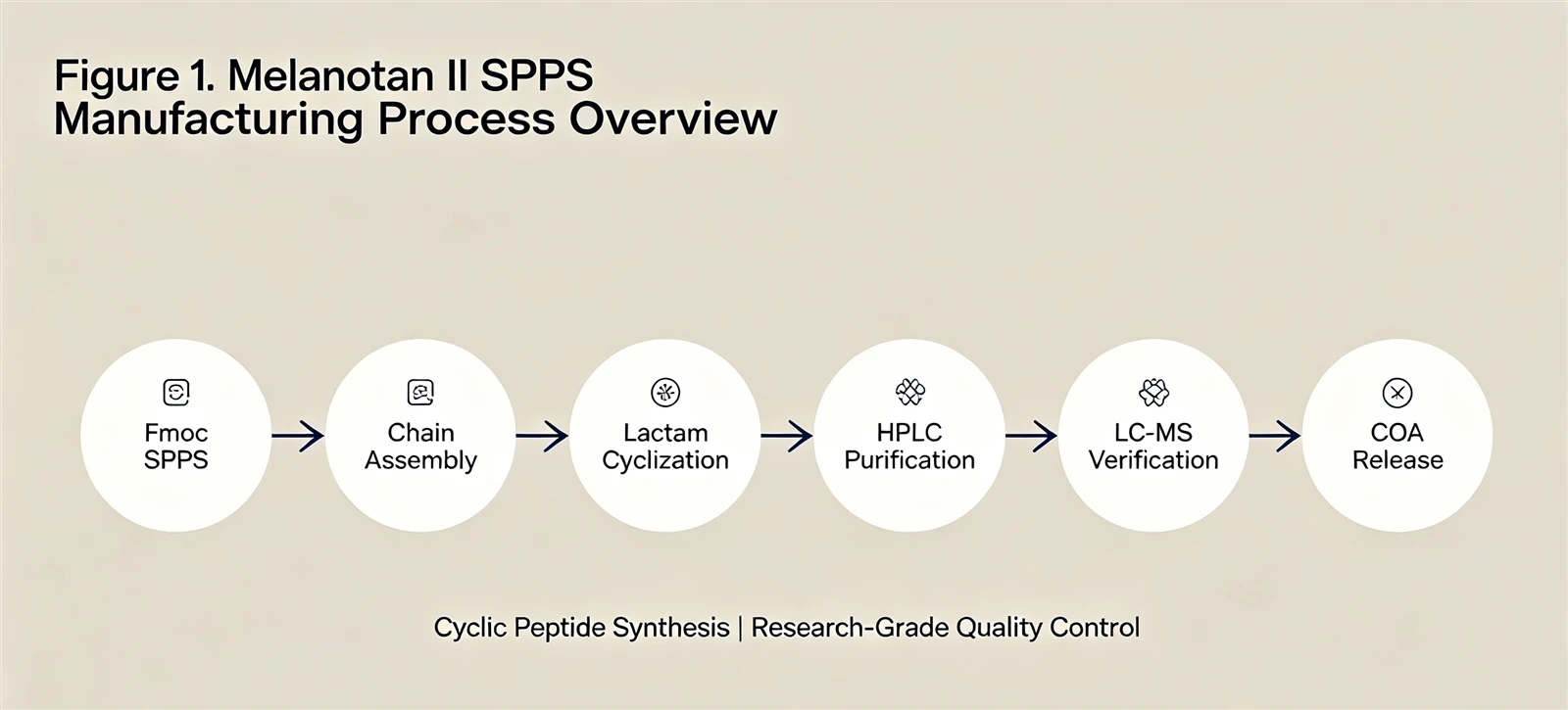
- Melanotan II peptide is primarily manufactured via Fmoc-based solid-phase peptide synthesis (SPPS), followed by side-chain lactam cyclization and multi-stage purification to form its stable cyclic bioactive structure.
- The full industrial production workflow includes resin loading, sequential amino acid coupling, on-resin cyclization, cleavage from solid support, preparative HPLC purification and final lyophilization.
- Research-grade Melanotan II production follows rigorous quality verification protocols via HPLC, LC-MS and moisture testing to ensure batch-to-batch consistency and a minimum purity of ≥98%.
Melanotan II is classified as a medium-difficulty cyclic peptide for scaled manufacturing, due to its required intramolecular lactam cyclization and high purity specifications for research use. For peptide manufacturers and R&D procurement teams, understanding the full synthesis workflow is critical for evaluating production capacity, quality control systems and supplier technical capability. This guide breaks down the complete industrial SPPS manufacturing process for Melanotan II, from resin loading to final certified release.
Melanotan II Peptide Sequence & Structural Characteristic
Melanotan II is a cyclic heptapeptide with the core sequence: Ac-Nle-c[Asp-His-D-Phe-Arg-Trp-Lys]-NH₂. Its defining manufacturing challenge is the formation of a side-chain lactam bridge between the β-carboxyl group of aspartic acid (Asp) and the ε-amino group of lysine (Lys), which creates the rigid cyclic conformation required for receptor binding activity.
Unlike linear peptides, cyclic structures require additional process controls during synthesis and cyclization to avoid intermolecular cross-linking, amino acid racemization and incomplete ring impurity formation.
Complete SPPS Manufacturing Workflow for Melanotan II
Industrial production of Melanotan II follows a standard Fmoc solid-phase peptide synthesis route, with dedicated cyclization and multi-stage purification steps tailored for cyclic heptapeptide production.
Resin Selection & Fmoc Amino Acid Loading
Production begins with selection of a suitable solid-phase resin. For C-terminal amidated Melanotan II, Rink Amide MBHA resin is the industry standard. The first Fmoc-protected amino acid - orthogonally side-chain protected lysine - is coupled to the resin via standard carbodiimide or uronium coupling chemistry.
Orthogonal side-chain protecting groups are strategically selected for Asp and Lys to allow selective deprotection and on-resin cyclization without cleaving the full peptide from the solid support.
Step-by-Step Amino Acid Coupling & Deprotection
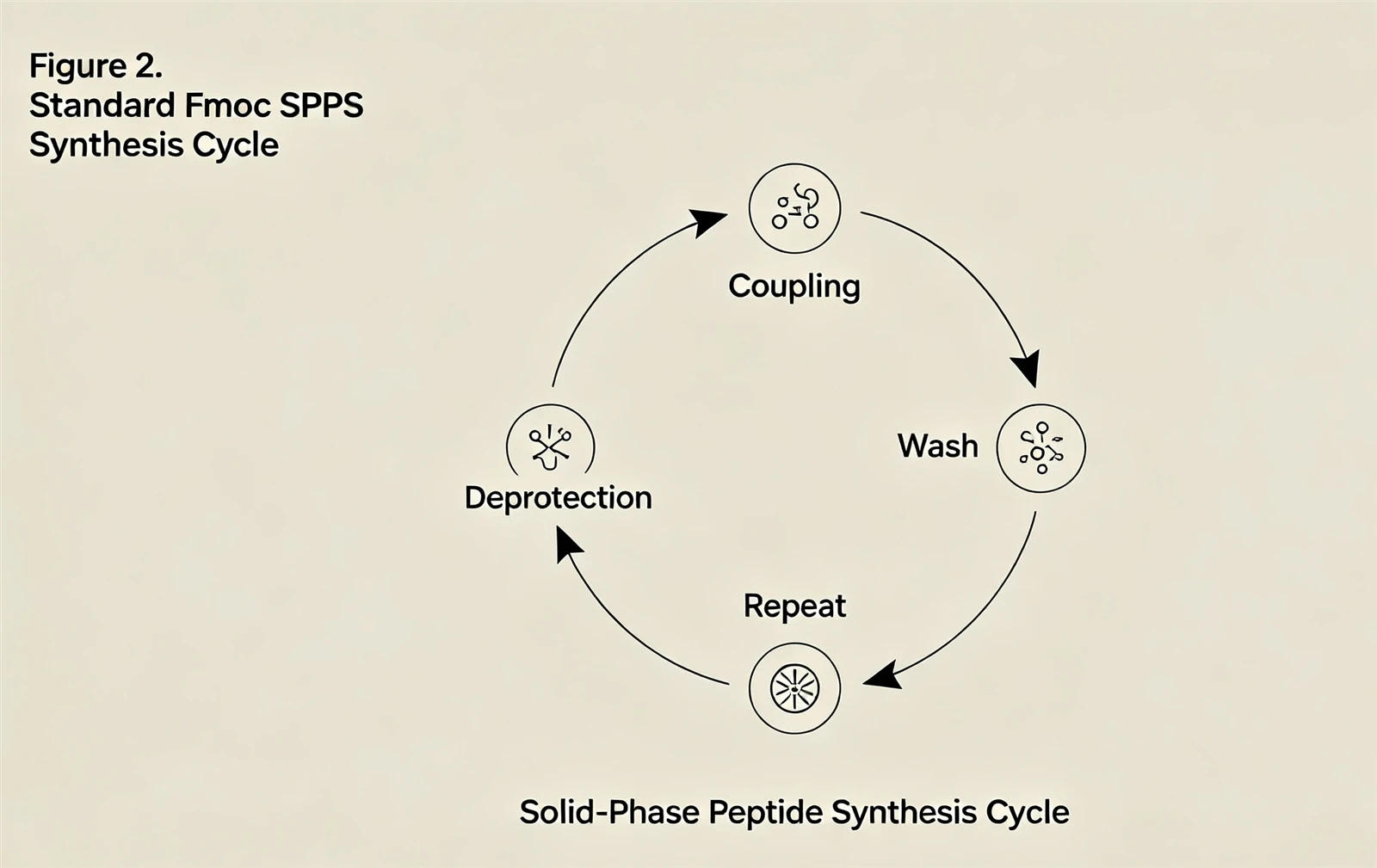
The peptide chain is assembled sequentially from C-terminus to N-terminus in repeating synthesis cycles:
- Fmoc Deprotection: Fmoc deprotection is performed using standard base-mediated deprotection conditions to expose the next amino acid coupling site.
- Resin Washing: The resin is thoroughly washed to remove residual deprotection reagents and cleaved Fmoc byproducts.
- Amino Acid Coupling: The next Fmoc-protected amino acid is activated using standard uronium or carbodiimide coupling reagents (e.g., HBTU, HATU) and added to the resin to form the new peptide bond.
- Cycle Repeat: Deprotection, washing and coupling steps are repeated until the full linear peptide sequence is assembled.
- N-Terminal Acetylation: After the final amino acid is added and deprotected, the N-terminus is acetylated using acetic anhydride to improve peptide metabolic stability.
On-Resin Side-Chain Lactam Cyclization
After full linear assembly and selective deprotection of the Asp and Lys side-chain protecting groups, intramolecular cyclization is performed while the peptide remains anchored to the resin. On-resin cyclization is preferred over solution-phase cyclization for Melanotan II because it reduces intermolecular oligomerization and improves overall reaction yield.
The cyclization reaction is typically carried out using standard peptide coupling reagents (e.g., PyBOP, HBTU) under dilute conditions to favor intramolecular ring formation over intermolecular side reactions.

Peptide Cleavage from Solid Resin
Once cyclization is confirmed complete, the crude peptide is cleaved from the resin using a cleavage cocktail, most commonly trifluoroacetic acid (TFA) with added scavengers such as triisopropylsilane (TIS) and water. Scavengers protect sensitive amino acid side chains from degradation during the acidic cleavage process.
After cleavage, the crude peptide is precipitated using cold diethyl ether, centrifuged and dried to yield crude Melanotan II powder. Crude purity typically ranges from 65–75% prior to purification.
Purification & Final Formulation Process
Crude Melanotan II requires multi-stage purification to meet research-grade specifications, followed by salt exchange and lyophilization for long-term stability.
Preparative HPLC Purification
The crude peptide is dissolved in an appropriate solvent and loaded onto a preparative reverse-phase HPLC system. Gradient elution using acetonitrile and water (with acid modifier) separates the target cyclic peptide from synthesis impurities, deletion sequences and incompletely cyclized byproducts.
Fractions are collected and analyzed by analytical HPLC; only fractions meeting pre-defined purity thresholds are pooled for further processing.
Salt Exchange & Desalting
After purification, the peptide is typically in TFA salt form. Depending on research requirements, salt exchange may be performed to convert the peptide to acetate salt form, which is the standard format for most laboratory research applications. The product is then desalted to remove residual organic solvents and buffer salts.
Vacuum Freeze Drying (Lyophilization)
The purified peptide solution is frozen and subjected to vacuum lyophilization to remove all residual moisture, yielding a stable, white to off-white lyophilized powder. Freeze drying preserves peptide activity and extends shelf life by minimizing hydrolytic degradation during storage.
In-Process & Final Quality Control
Research-grade Melanotan II production follows rigorous quality testing at every stage of manufacturing to ensure consistency and compliance with research material standards.
HPLC Purity Analysis
Analytical reverse-phase HPLC is the primary method for determining peptide purity. Final standard research-grade product must meet a minimum purity of 98%, with no single individual impurity exceeding 1.0%.
LC-MS Molecular Weight Confirmation
Liquid chromatography-mass spectrometry (LC-MS) is used to verify the exact molecular weight of the synthesized peptide, confirming correct amino acid composition and successful lactam cyclization. The expected molecular weight of Melanotan II is 1024.18 Da.
Additional Quality Testing
Moisture content analysis (Karl Fischer method)
Heavy metal screening (Pb, As, Cd, Hg)
Endotoxin testing (LAL assay, for cell culture grade material)
Amino acid composition analysis
Solubility verification

Common Manufacturing Challenges & Solutions
Melanotan II production presents two primary technical challenges that differentiate high-quality manufacturers from low-cost suppliers:
- Incomplete cyclization: Insufficient reaction control or improper reagent selection leads to high levels of linear impurity. Solution: Optimize cyclization time, reagent concentration and resin loading density, with in-process HPLC monitoring to confirm reaction completion.
- Low overall yield: Multi-step synthesis and purification result in typical overall yields of 15–25% for industrial-scale production. Solution: Systematic process optimization of coupling efficiency, cyclization yield and purification fraction recovery.
How Manufacturing Capability Affects Melanotan II Peptide Quality
When evaluating Melanotan II sourcing options, manufacturing infrastructure directly determines final product quality, batch consistency and long-term supply reliability. Three core capabilities are the strongest indicators of supplier performance:
Synthesis Scale Flexibility Reputable manufacturers support seamless scaling from milligram-scale research batches to multi-kilogram commercial production runs, with standardized processes that maintain purity and yield across batch sizes. Small-only suppliers often struggle with consistency when scaling up cyclic peptide production.
Preparative Purification Capacity High-purity Melanotan II relies on high-performance preparative HPLC systems with dedicated fraction collection and in-line analytical verification. Suppliers with limited purification capacity often cut fraction thresholds to increase yield, resulting in higher impurity levels and variable batch quality.
End-to-End Analytical Verification Trusted suppliers operate in-house analytical laboratories with full HPLC, LC-MS and ancillary testing capabilities, rather than outsourcing quality verification. In-house testing enables faster release, full traceability and direct technical support for research-specific quality requirements.
FAQ
How long does Melanotan II synthesis take?
Standard research-scale Melanotan II production typically takes 7–10 business days from resin loading to final lyophilized product, including full analytical quality verification. Larger commercial-scale batches may require 2–4 weeks depending on batch size and custom purity specifications.
Why is cyclic peptide synthesis more challenging than linear peptide synthesis?
Cyclic peptide synthesis requires controlled intramolecular bond formation - such as the Asp-Lys lactam bridge in Melanotan II - without triggering intermolecular cross-linking, amino acid racemization or incomplete ring closure. This adds process complexity, lower overall yields and stricter purification requirements compared to linear peptide manufacturing
.
What tests confirm Melanotan II peptide identity and purity?
Melanotan II molecular identity is confirmed via LC-MS mass spectrometry to match the expected molecular weight of 1024.18 Da. Purity is quantified by analytical reverse-phase HPLC, with additional testing including moisture content, heavy metal screening and endotoxin analysis for research-grade material.
Research-Grade Melanotan II Manufacturing Support
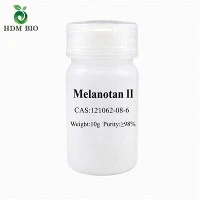
HDM BIO provides research-grade Melanotan II peptide with full analytical documentation including HPLC chromatograms, LC-MS spectra and batch COA for qualified laboratory and preclinical research applications. To request a quote, download a product datasheet or discuss custom batch specifications, visit our official product page.