


As the global GLP-1 market continues to expand, semaglutide remains one of the most widely discussed peptides in pharmaceutical development, metabolic research, and obesity-related studies.Among the questions frequently raised by researchers and industry professionals, one topic consistently appears:
How should semaglutide be reconstituted correctly?
Although reconstitution is often considered a routine preparation step, improper handling can influence peptide stability, solution quality, solubility, and experimental consistency. In many situations, issues that appear to be related to semaglutide itself are actually caused by preparation errors, storage conditions, or raw material quality differences.This guide explains the principles behind semaglutide reconstitution, common mistakes to avoid, factors that influence solution quality, and practical recommendations for achieving more consistent results.
What Does Reconstituting Semaglutide Mean?

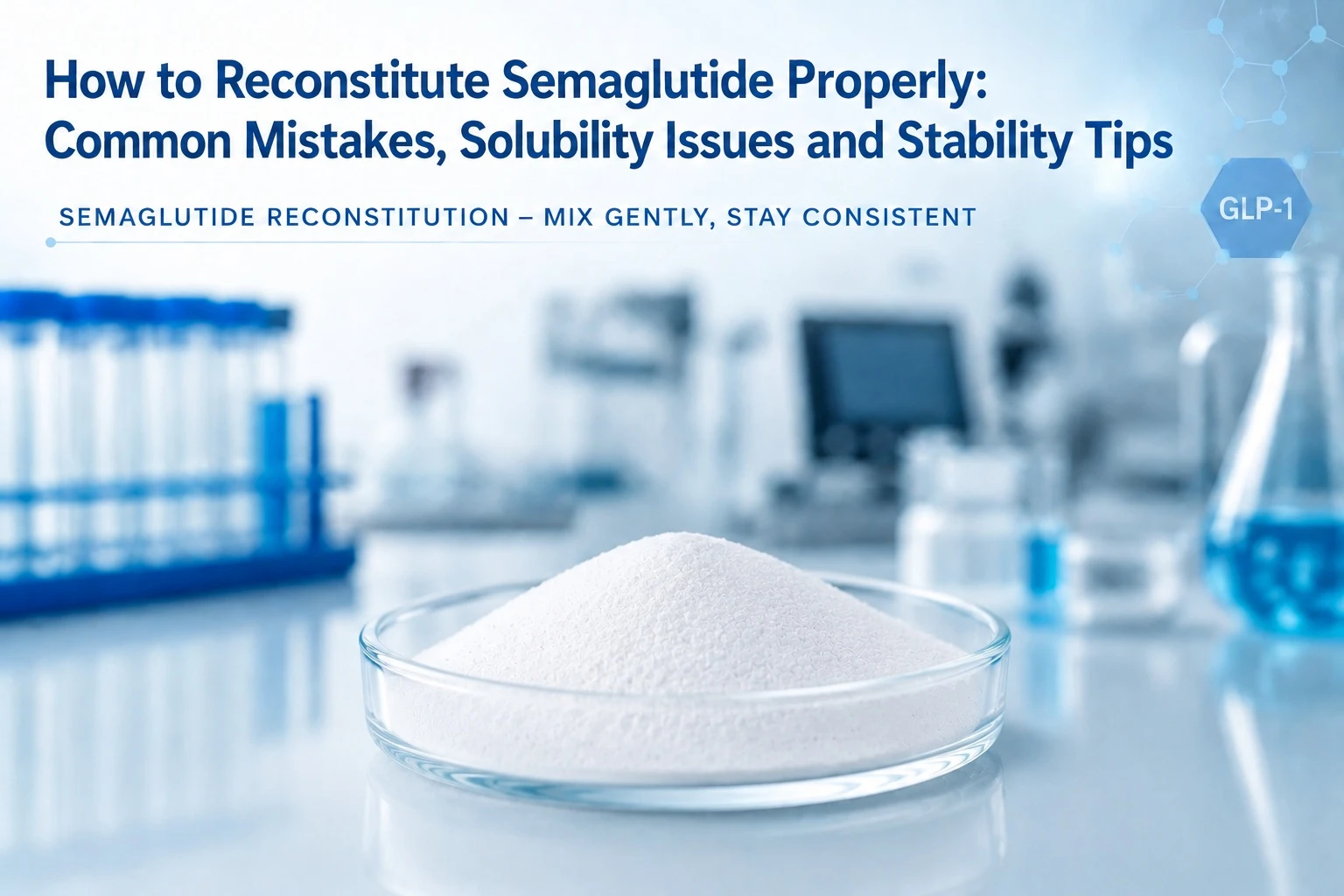
Semaglutide is commonly supplied as a lyophilized (freeze-dried) powder rather than a ready-to-use liquid formulation.Reconstitution refers to the process of combining this freeze-dried peptide powder with a suitable sterile solvent to create a homogeneous solution.The objective is not simply to dissolve the powder. Proper reconstitution helps maintain peptide integrity, preserve biological activity, and support concentration consistency throughout the solution.Because peptides are complex biological molecules, even small differences in handling techniques may affect the final outcome.
Why Is Semaglutide Supplied as a Lyophilized Powder?
Many researchers ask why semaglutide powder is usually supplied in freeze-dried form instead of as a liquid.
The answer is stability.
Peptides are naturally sensitive to:
● Moisture
● Temperature changes
● Oxidation
● Environmental exposure
Lyophilization removes water while helping preserve peptide structure.
Compared with liquid formulations, lyophilized semaglutide generally offers:
● Improved storage stability
● Better transportation tolerance
● Lower degradation risk
● Longer shelf life
● Easier inventory management
For these reasons, freeze-drying has become one of the most widely used preservation techniques in peptide manufacturing.
Why Proper Reconstitution Matters
Reconstitution may appear straightforward, but it directly influences overall solution quality.
Improper preparation may contribute to:
● Incomplete dissolution
● Visible particles
● Uneven concentration
● Reduced stability
● Poor reproducibility
● Variable experimental outcomes
For pharmaceutical developers and research laboratories, maintaining consistency is essential for generating reliable results.
Common Mistakes During Semaglutide Reconstitution
Several preparation mistakes repeatedly appear across peptide handling discussions and technical documentation.
Injecting Solvent Too Quickly
Rapid solvent addition can disturb the lyophilized cake and slow complete dissolution.
Shaking the Vial Aggressively
Many users assume vigorous shaking helps peptides dissolve faster.In reality, excessive agitation can increase foam formation and place unnecessary stress on peptide structures.
Poor Sterility Control
Peptide preparation should always be performed using appropriate sterile handling procedures.Contamination may negatively affect both solution quality and storage stability.
Ignoring Storage Conditions
Temperature fluctuations before or after preparation may contribute to stability issues.
Signs of Successful Reconstitution
One of the most common questions involves determining whether reconstitution was performed successfully.
Several visual indicators may help.
Clear Appearance
The solution should appear transparent and uniform.
No Visible Particles
Undissolved particles may suggest incomplete dissolution or handling issues.
Consistent Appearance Throughout the Vial
The solution should appear homogeneous from top to bottom.
No Residual Powder
Powder remaining on vial surfaces may indicate incomplete dissolution.
Although visual inspection cannot replace analytical testing, it often provides useful preliminary information.
Semaglutide Troubleshooting Guide

Many commonly reported issues can often be traced to handling or storage factors.
| Observation | Possible Cause |
| Cloudy Solution | Incomplete Dissolution |
| Visible Particles | Improper Mixing |
| Foam Formation | Excessive Agitation |
| Uneven Appearance | Rapid Solvent Addition |
| Poor Stability | Temperature Fluctuations |
| Variable Results | Raw Material Quality Differences |
Understanding these factors can help improve consistency and reproducibility.
Why Do Particles Sometimes Appear?
Visible particles are among the most frequently discussed concerns surrounding peptide preparation.
Potential causes include:
● Incomplete dissolution
● Improper mixing technique
● Temperature-related instability
● Poor storage conditions
● Raw material quality variation
In many situations, particles result from multiple contributing factors rather than a single cause.
Understanding these variables can help reduce preparation inconsistencies.
Does API Quality Affect Reconstitution?
Absolutely.Even when handling procedures are performed correctly, the quality of the underlying semaglutide API remains a critical factor.
Higher-quality materials generally demonstrate:
● Better solubility
● More consistent dissolution
● Improved batch-to-batch stability
● Lower impurity levels
● More predictable performance
Conversely, lower-quality materials may contribute to cloudy appearance, incomplete dissolution, and inconsistent solution characteristics.This is one reason pharmaceutical manufacturers place significant emphasis on supplier qualification and analytical verification.
Practical Tips for Better Reconstitution Results

Researchers and peptide professionals often follow several best practices to improve consistency.
Allow Materials to Reach Appropriate Conditions
Avoid unnecessary temperature stress before preparation.
Handle Solutions Gently
Aggressive agitation is rarely beneficial for peptide stability.
Inspect Solutions Carefully
Visual inspection may help identify dissolution problems before use.
Maintain Consistent Procedures
Using the same preparation methods can improve reproducibility across experiments.
Record Preparation Conditions
Documenting preparation details may help identify sources of variability later.
Storage Considerations After Reconstitution
Preparation is only one part of the process.Storage conditions after reconstitution can also influence long-term solution quality.
Important considerations include:
● Stable temperature conditions
● Protection from excessive light exposure
● Avoiding repeated temperature fluctuations
● Maintaining container integrity
● Minimizing unnecessary handling
● Proper storage practices help preserve peptide stability and reduce the likelihood of degradation.
Frequently Asked Questions
Why is semaglutide supplied as a powder instead of a liquid?
Freeze-drying improves stability and helps preserve peptide integrity during storage and transportation.
Why should semaglutide not be shaken aggressively?
Excessive shaking may increase foam formation and potentially affect peptide stability.
What causes a cloudy solution?
Cloudiness may result from incomplete dissolution, storage conditions, handling issues, or raw material quality.
Do visible particles always indicate poor quality?
Not necessarily. Particles may result from preparation technique, storage conditions, or incomplete dissolution.
Does API purity influence solubility?
Yes. Higher-purity semaglutide generally demonstrates more consistent dissolution and solution quality.
Why is sterility important?
Proper sterility helps maintain solution quality and reduces contamination risks.
Why does semaglutide sometimes dissolve slowly?
Dissolution speed may be affected by handling procedures, solvent interaction, and storage history.
Can storage conditions affect solution quality?
Yes. Temperature fluctuations and environmental exposure may negatively influence peptide stability.
What causes bubbles during preparation?
Bubbles are often associated with excessive agitation or rapid solvent addition.
How can researchers improve reproducibility?
Consistent preparation techniques, proper storage practices, and high-quality API materials all contribute to improved reproducibility.
Key Takeaways
Semaglutide is typically supplied as a lyophilized powder to improve stability.
Proper reconstitution helps maintain peptide integrity and concentration consistency.
Common preparation mistakes include rapid solvent addition, excessive shaking, and poor sterility control.
Cloudiness and particles are often associated with handling, storage, or raw material quality factors.
API quality plays a significant role in solubility, dissolution behavior, and batch consistency.
Proper storage remains important even after successful reconstitution.
Final Thoughts
Semaglutide reconstitution is often viewed as a simple preparation step, yet it has a direct impact on solution consistency, stability, and overall performance.By understanding the principles behind peptide handling, avoiding common mistakes, and paying close attention to material quality and storage conditions, researchers and industry professionals can achieve more reliable and reproducible outcomes.As peptide-based pharmaceutical development and metabolic research continue to expand in 2026, proper handling practices will remain just as important as the peptide itself.
Need High-Purity Semaglutide API?
✓ COA Available
✓ HPLC Tested
✓ Global Shipping
✓ Bulk Supply Support
Whatsapp & Mobile: +8619991242181
Email: sales@hdmbio.com