






Mitochondrial function remains one of the most active areas of investigation in aging biology, metabolic disease and degenerative disorder research. Among the molecular tools used to probe mitochondrial membrane integrity and bioenergetics, SS-31 - the synthetic aromatic-cationic tetrapeptide also known by the INN name elamipretide, or MTP-131 - is a well-characterized cardiolipin-targeted research peptide.
This article reviews the current state of SS-31 research, established and emerging clinical evidence, translational limitations, and the quality and sourcing considerations that matter most to research buyers and procurement teams.
2026 Research Perspective
A 2026 peer-reviewed review in Frontiers in Physiology examines cardiolipin remodeling as a mitochondrial therapeutic strategy, and evaluates the translational evidence chain for elamipretide and related compounds. The review frames SS-31 as a prototypical cardiolipin-binding peptide, and discusses both the mechanistic rationale and the gaps between preclinical observations and clinical outcomes across indications.
Key themes from the analysis include:
Cardiolipin stabilization is a biologically plausible therapeutic strategy supported by strong preclinical data.
Mechanistic improvements in mitochondrial respiration do not reliably translate into organ-level functional benefit across all disease contexts.
Clinical outcomes remain indication-specific, and benefit in one population does not imply benefit in another.
This framework is particularly relevant for SS-31 research in 2026, as the field moves from mechanistic characterization toward more selective clinical development.
Research Background
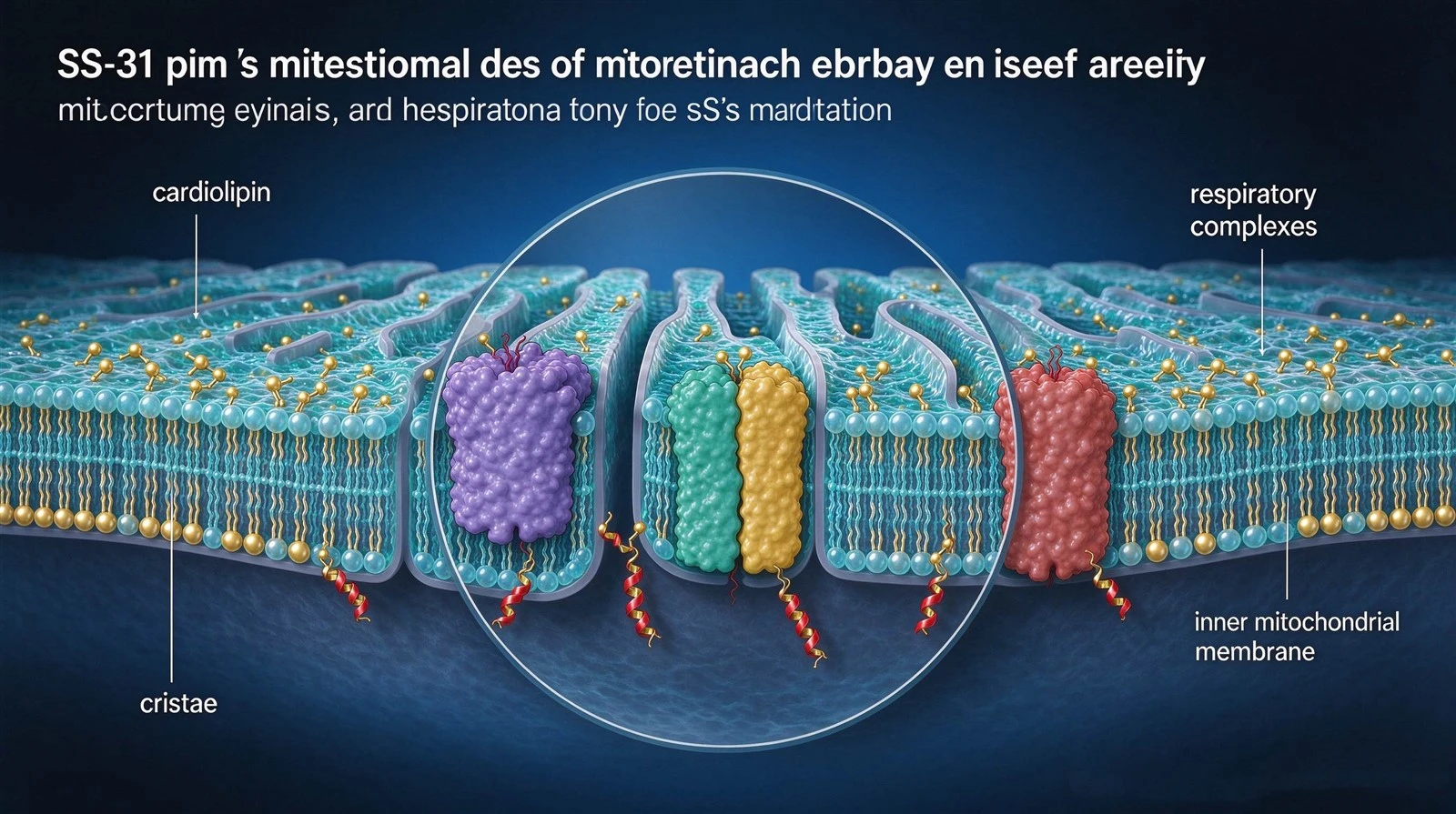
At the center of SS-31 research is cardiolipin, a dimeric phospholipid highly enriched in the inner mitochondrial membrane. Cardiolipin is not merely a structural lipid; it supports cristae architecture, stabilizes respiratory chain supercomplexes, and maintains efficient oxidative phosphorylation. Under conditions of oxidative stress, aging and disease, cardiolipin peroxidation and depletion can disrupt membrane structure, reduce respiratory efficiency and contribute to mitochondrial dysfunction.
Because of its central role in mitochondrial health, compounds that interact with cardiolipin and support membrane organization have become important research tools across multiple disease areas.
Current Research Focus
Three major directions continue to drive SS-31 research in 2026:
Disease models and clinical translation
Preclinical work continues across ischemia-reperfusion injury, myopathies, renal injury and neurodegeneration models. Clinically, the most established development remains the September 2025 accelerated FDA approval of Forzinity™ (elamipretide injection) for improving muscle strength in adult and pediatric patients with Barth syndrome weighing at least 30 kg. Approval was based on knee extensor muscle strength as an intermediate endpoint, and post-marketing confirmatory studies are required.
Beyond Barth syndrome, elamipretide has been studied in additional mitochondrial and cardiometabolic indications, with varying levels of evidence. Translational success across indications remains an active area of investigation and debate.Mitochondrial bioenergetics
Studies continue to explore how membrane-targeted peptides influence respiratory chain efficiency, proton leak and ATP production under both resting and stressed conditions. This line of work underpins the rationale for testing SS-31 in energy-deficiency disorders.
Membrane structure and stability
Biophysical and cellular work continues to clarify how peptide-membrane interactions preserve cristae organization and limit cardiolipin peroxidation during stress. This cardiolipin-targeting membrane stabilization model remains the core proposed mechanism of action for SS-31.
For a deeper look at the molecular mechanism, see our full guide on SS-31 mechanism of action.
Evidence and Limitations
Evidence strength varies substantially by study type:
Mechanistic and biophysical studies provide the strongest support for the cardiolipin interaction model.
Cell culture studies have investigated mitochondrial respiration and stress resistance across multiple cell types.
In vivo animal studies show beneficial effects in multiple disease models, but magnitude varies by model, dose and route.
Human clinical evidence is most developed for the specific approved indication and formulation, and remains limited or mixed for other indications.
Clinical results have not been uniformly positive across indications. In the phase 3 MMPOWER-3 trial in primary mitochondrial myopathy, elamipretide did not meet its primary endpoints for six-minute walk distance or total fatigue at 24 weeks. This result highlights why findings from mechanistic studies, animal models and one clinical population should not be generalized to other diseases without indication-specific evidence.
The FDA approval applies to Forzinity, a specific elamipretide injection product for the labeled Barth syndrome indication. It should not be interpreted as approval of research-grade SS-31 peptide powder, other formulations or other disease indications. Regulatory status and permitted uses must be assessed separately for each product and jurisdiction.
Peptide Quality Considerations
As research advances, the quality of the peptide raw material itself remains a foundational but often overlooked factor. Studies with poorly characterized material can produce variable or irreproducible results.
Key quality considerations for research buyers include:
Confirmation of correct peptide identity, not just a purity number
Distinction between HPLC chromatographic purity and actual peptide content by weight
Batch-specific quality documentation, not generic product spec sheets
Traceability between the Certificate of Analysis and the supplied material
For research teams, investing in proper quality verification upstream reduces experimental risk downstream. For a complete quality and COA checklist, see our SS-31 peptide quality evaluation guide.
B2B Sourcing Perspective
For procurement teams sourcing SS-31, the lowest price per gram is rarely the best value. Buyers should compare material on the basis of:
Identity verification method
Purity assay and calculation basis
Batch-specific documentation
Lead time, packaging and shipping conditions
Supplier technical support
Conclusion
SS-31 remains a prominent research tool for mitochondrial biology, supported by a broad base of preclinical evidence and continued clinical investigation across selected indications, with results varying by indication. The 2025 FDA approval for Barth syndrome represents the most advanced translational milestone, while broader clinical development continues alongside ongoing mechanistic research.
For research buyers, understanding both the scientific landscape and the quality considerations for sourcing is essential for reproducible work.
For product specifications, batch documentation and bulk sourcing options, visit the SS-31 Peptide Powder product page.
References
U.S. Food and Drug Administration. Forzinity (elamipretide) injection - accelerated approval. September 2025.
Sparvero L., et al. (2026). Cardiolipin remodelling in mitochondrial therapeutics: translational evidence chains from elamipretide to emerging strategies. Front Physiol. 17:1813119. https://doi.org/10.3389/fphys.2026.1813119
Szeto H.H. (2018). Cardiolipin-targeted peptides for mitochondrial dysfunction. Pharmacol Ther. 186:102-113.