



If you've been researching semaglutide, you've probably come across one of the most frequently asked questions surrounding this peptide:
How long does semaglutide stay in your system?
At first glance, the answer seems simple.However, many people are surprised to learn that semaglutide behaves very differently from many traditional medications and shorter-acting peptides.Its extended half-life is one of the key reasons it has attracted significant attention in pharmaceutical development, metabolic research, and peptide science.But how long does it actually remain in the body? Why can it continue to exert effects long after administration? And what happens after semaglutide is discontinued?This guide explains the science behind semaglutide persistence, the factors that influence elimination, and why understanding half-life is important for researchers, pharmaceutical developers, and industry professionals.
Quick Answer: How Long Does Semaglutide Stay in Your System?
Semaglutide has a biological half-life of approximately one week.Because only part of the compound is eliminated during each half-life cycle, semaglutide may remain present in the body for several weeks after administration.This extended duration is one of the reasons semaglutide-related formulations are commonly associated with weekly dosing schedules.However, elimination timelines may vary depending on physiological factors, formulation characteristics, and individual variability.
Why Do So Many People Ask This Question?
Interestingly, most people searching this topic are not actually asking about pharmacokinetics.They are usually trying to understand:Why semaglutide continues working after administrationWhy weekly dosing is possibleWhat happens after discontinuationHow long residual amounts remain in the bodyWhy semaglutide behaves differently from many other peptidesUnderstanding how long semaglutide remains present helps explain many of its most distinctive characteristics.
Why Does Semaglutide Last Longer Than Many Other Peptides?
Not all peptides remain in the body for the same amount of time.Many traditional peptides are rapidly broken down and eliminated.
Semaglutide Powderwas specifically engineered to remain active longer.
Several structural characteristics contribute to its extended duration:Enhanced molecular stabilityResistance to enzymatic degradationStrong plasma protein bindingOptimized pharmacokinetic propertiesThese features help reduce clearance rates and support longer persistence.This is one reason semaglutide became such an important advancement in peptide development.
What Does Half-Life Actually Mean?
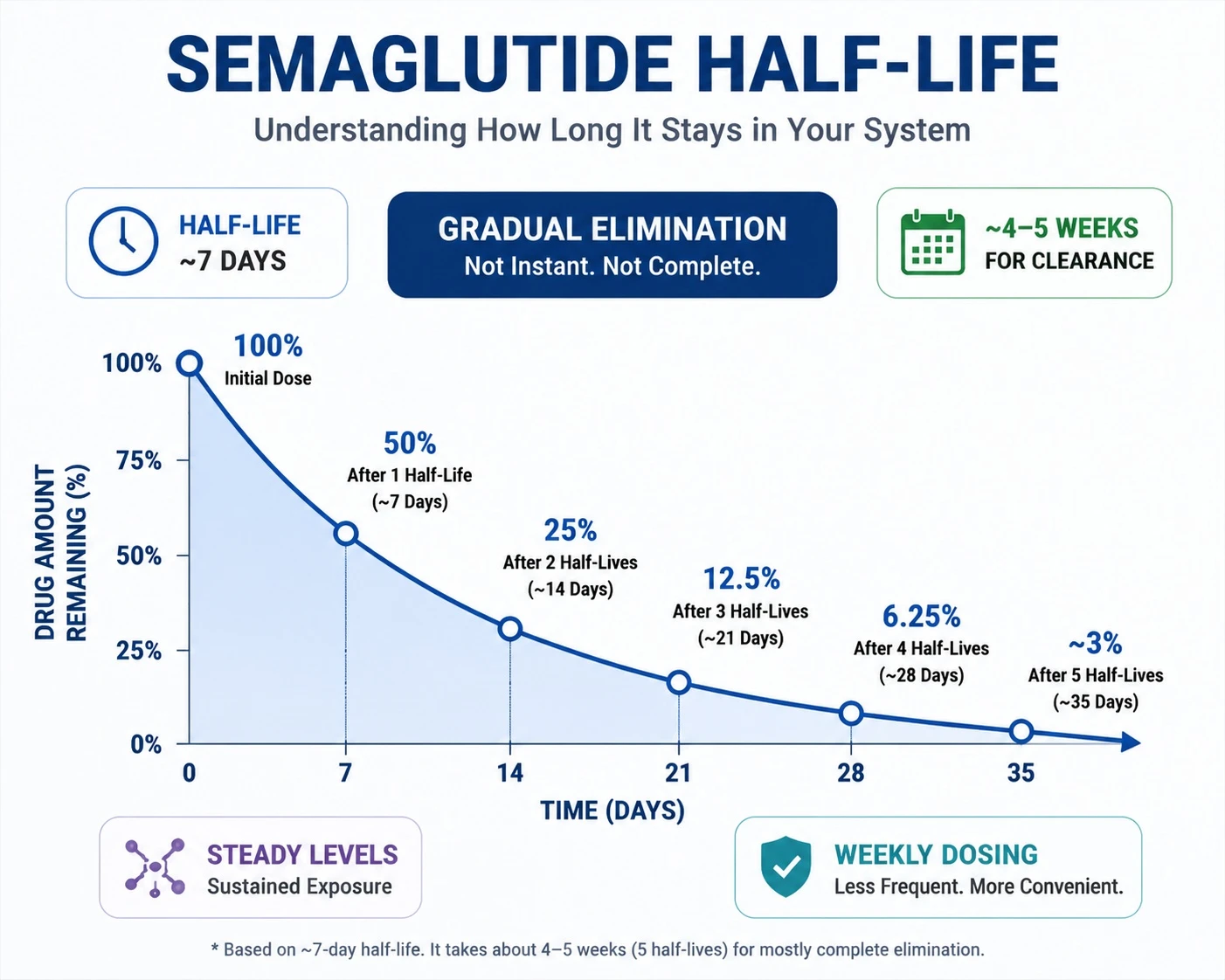
One of the most misunderstood concepts is half-life.Many people assume that a compound disappears completely after one half-life.That is not how pharmacokinetics works.A half-life refers to the time required for approximately half of the compound to be eliminated.For example:
| Time | Approximate Amount Remaining |
| Initial Dose | 100% |
| After 1 Half-Life | 50% |
| After 2 Half-Lives | 25% |
| After 3 Half-Lives | 12.5% |
| After 4 Half-Lives | 6.25% |
| After 5 Half-Lives | ~3% |
This gradual decline explains why semaglutide may remain present long after administration.
Common Misconceptions About Semaglutide Half-Life
Understanding what half-life means also helps correct several common misconceptions.
Myth 1: Semaglutide Is Gone After One Week
Reality:A one-week half-life does not mean complete elimination after one week.
Only approximately half of the compound is eliminated during that period.
Myth 2: Longer Persistence Means Stronger Effects
Reality:Duration and intensity are not the same thing.
A compound may remain present while its biological activity gradually changes over time.
Myth 3: Everyone Eliminates Semaglutide at the Same Rate
Reality:Individual physiological differences may influence pharmacokinetic behavior and elimination timelines.
Why Is Semaglutide Often Associated With Weekly Dosing?
A common question is:If semaglutide stays in the body for so long, why isn't it administered more frequently?The answer lies in maintaining relatively stable exposure levels.Because semaglutide persists for an extended period, frequent administration is generally unnecessary.
Its long half-life helps support:
■ Sustained exposure
■ Stable concentration profiles
■ Reduced dosing frequency
■ Improved convenience
These characteristics distinguish semaglutide from many shorter-acting peptide compounds.
What Factors Influence How Long Semaglutide Stays in the Body?
There is no single elimination timeline that applies to everyone.Several variables may influence persistence.
Individual Metabolism
Metabolic differences may influence clearance rates.
Body Composition
Distribution characteristics can vary among individuals.
Age and Physiological Factors
Certain physiological variables may influence pharmacokinetic behavior.
Formulation Characteristics
Different formulations may exhibit different release and absorption profiles.
These variables help explain why elimination timelines are not identical across all individuals.
What Happens After Semaglutide Is Discontinued?
This is one of the most searched questions online.Many people expect semaglutide to disappear immediately after discontinuation.In reality, elimination is gradual.As circulating levels decline:Exposure decreases progressivelyResidual amounts continue decliningElimination continues through normal metabolic pathwaysBecause of semaglutide's long half-life, complete clearance may take several weeks rather than several days.
Does Semaglutide Accumulate Over Time?

Another common question involves accumulation.Because semaglutide remains present between dosing intervals, repeated administration may contribute to accumulation until relatively stable levels are achieved.This phenomenon is common among compounds with long half-lives.Over time, administration and elimination begin reaching a more balanced state.This helps explain why pharmacokinetic behavior often differs after repeated exposure compared with initial administration.
Practical Insights From Peptide Development
Researchers working with long-acting peptides often pay close attention to half-life because persistence can influence study design, sampling schedules, and interpretation of results.Longer-lasting compounds may require:Extended observation periodsDifferent sampling strategiesCareful interpretation of residual exposureAdditional pharmacokinetic considerationsThis is one reason half-life remains a central topic throughout peptide development programs.
How Does Semaglutide Compare With Other GLP-1 Peptides?
Semaglutide is frequently compared with other GLP-1 related compounds.One of the most significant differences involves duration of action.
| Characteristic | Semaglutide | Shorter-Acting Peptides |
| Half-Life | Longer | 2–13 hours (short-acting) |
| Dosing Frequency | Less Frequent | Daily or twice daily |
| Persistence | Extended | Rapid clearance from bloodstream |
| Pharmacokinetic Stability | Higher | Lower stability, fluctuating concentration |
This extended persistence remains one of semaglutide's most distinguishing characteristics.
Why Are Long-Acting Peptides Becoming More Important?
The pharmaceutical industry continues moving toward longer-acting therapies.Several factors are driving this trend:
Improved Convenience
Less frequent administration may improve adherence and simplify treatment schedules.
More Stable Exposure
Longer-lasting compounds often help maintain more consistent concentration profiles.
Continued Peptide Innovation
Researchers continue exploring technologies that improve peptide stability and duration.
For these reasons, long-acting peptides are expected to remain an important area of pharmaceutical innovation.
Why Does Understanding Half-Life Matter?
Understanding half-life helps explain:
◆ Dosing intervals
◆ Accumulation patterns
◆ Elimination timelines
◆ Exposure stability
◆ Pharmacokinetic behavior
For pharmaceutical developers and researchers, these factors are essential when evaluating peptide performance.
Frequently Asked Questions
How long does semaglutide stay in your system?
Semaglutide may remain present for several weeks because of its approximately one-week half-life.
What is the half-life of semaglutide?
The biological half-life is generally around one week.
Why does semaglutide last so long?
Its molecular design improves stability, reduces degradation, and supports extended persistence.
Does semaglutide accumulate over time?
Yes. Repeated administration may contribute to accumulation until relatively stable levels are achieved.
How long after stopping semaglutide does it remain in the body?
Residual amounts may remain for several weeks because elimination is gradual.
Does everyone eliminate semaglutide at the same rate?
No. Individual physiological differences may influence clearance rates.
Why is semaglutide associated with weekly dosing?
Its extended half-life helps maintain exposure levels for longer periods.
Is semaglutide eliminated immediately after discontinuation?
No. Elimination occurs progressively rather than instantly.
What factors affect semaglutide elimination?
Metabolism, physiology, formulation characteristics, and individual variability may all contribute.
Why is understanding half-life important?
Half-life helps explain dosing frequency, persistence, accumulation, and elimination behavior.
Why is semaglutide considered a long-acting peptide?
Its structural design helps extend persistence compared with many traditional peptides.
Does a longer half-life mean better performance?
Not necessarily. Half-life influences duration, but performance depends on multiple pharmacological factors.
Key Takeaways
Semaglutide has a relatively long half-life of approximately one week.The compound may remain present for several weeks after administration.Extended persistence helps support weekly dosing schedules.Elimination occurs gradually rather than immediately.Individual physiological differences may influence clearance timelines.Understanding half-life helps explain accumulation, dosing intervals, and pharmacokinetic behavior.Long-acting peptide technologies are expected to remain an important area of pharmaceutical innovation.
Final Thoughts
One of the defining characteristics of semaglutide is its long duration of action.Unlike many traditional peptides that are rapidly cleared, semaglutide was specifically designed to remain active for extended periods. This pharmacokinetic profile has helped make it one of the most influential GLP-1 related compounds in modern pharmaceutical development.As research and industry interest continue to grow, understanding how long semaglutide stays in the body remains an important part of understanding how the peptide works.
Need High-Purity Semaglutide API?
✓ COA Available
✓ HPLC Tested
✓ Global Shipping
✓ Bulk Supply Support
Whatsapp & Mobile: +8619991242181
Email: sales@hdmbio.com