


Elcatonin (CAS 60731-46-6) is a synthetic calcitonin analogue investigated in research on calcium regulation, bone metabolism and calcitonin-related pharmacology. It is structurally derived from eel calcitonin and is distinguished by a specific N-terminal modification that replaces the native disulfide bridge.
This article covers the basic identity of Elcatonin, its molecular properties, its relationship to natural eel calcitonin, research context, and the quality considerations that matter when sourcing the powder.
What Is Elcatonin?
Elcatonin Powder is a synthetic analogue of eel calcitonin, a 32-amino-acid peptide hormone involved in calcium homeostasis. It is also known under the designations Carbocalcitonin and (Asu¹,⁷)-Calcitonin (eel).
- Key identity information:
- CAS number: 60731-46-6
- Peptide class: Synthetic calcitonin analogue
Relationship: Structurally derived from eel calcitonin, not extracted from eel tissue
It is important to distinguish the synthetic analogue from the natural hormone. Elcatonin is a designed molecule with a structural modification at the N-terminal ring, which is the basis of its distinct identity in research use.
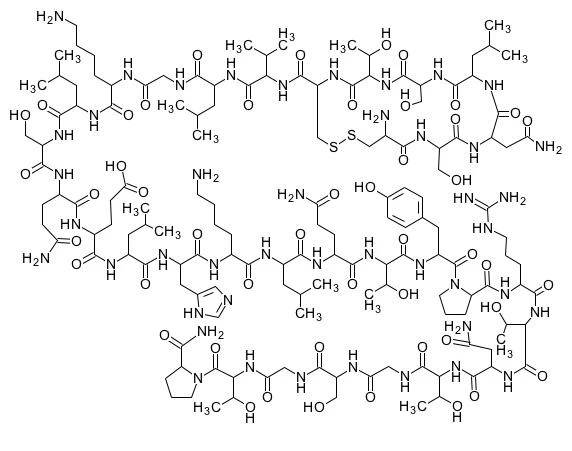
Elcatonin Molecular Structure and Key Properties
Core identity parameters for Elcatonin:
| Property | Value |
|---|---|
| CAS number | 60731-46-6 |
| Molecular formula | C₁₄₈H₂₄₄N₄₂O₄₇ |
| Molecular weight | 3363.77 g/mol |
| Amino acid residues | 32 |
| Structural feature | Asu¹,⁷ modification (carbon–carbon linkage in the deamino-dicarba analogue) |
| Alternative names | Carbocalcitonin, (Asu¹,⁷)-Calcitonin (eel) |
Note: These values describe the free peptide identity. Supplied material may exist as a salt form (e.g., Elcatonin Acetate), and molecular weight, assay basis and content calculations must be verified against the specific grade documentation.
How Does Elcatonin Differ from Natural Eel Calcitonin?
Natural eel calcitonin contains a disulfide bond between cysteine residues at positions 1 and 7, forming the N-terminal ring structure.
In Elcatonin, the native Cys¹–Cys⁷ disulfide bond is replaced by a carbon–carbon linkage in the deamino-dicarba analogue. The structural modification is associated with differences in conformational behavior and in vitro stability compared with native calcitonin.
It should be noted that structural stability observed under controlled experimental conditions does not automatically translate into a specific shelf life or clinical advantage for all formulations. Stability claims must be supported by product-specific data.
Elcatonin Research Background
Research on Elcatonin and other calcitonin analogues focuses on:
- Calcitonin receptor pharmacology and calcium regulation
- Bone metabolism and osteoclast-related research models
- Comparative studies of calcitonin peptides from different species
- Peptide structure–activity relationship studies
Early studies examined the biological activity of [Asu¹,⁷]-eel calcitonin and the contribution of the native disulfide bond to calcitonin activity. Subsequent comparative research also investigated the in vitro stability of the modified analogue. These findings provide historical context for understanding Elcatonin's molecular design, but they should not be interpreted as proof of equivalent performance across formulations or experimental settings.
Historical clinical use of calcitonin-class peptides should not be presented as a current, universally applicable treatment recommendation. For research buyers, Elcatonin is a characterized peptide material for experimental and development use.
Elcatonin Powder Specifications and Quality Considerations
When sourcing Elcatonin powder, verify:
- Product name, CAS number, salt form and specification
- Molecular formula and molecular weight against supplier documentation
- Analytical methods used, including HPLC and LC-MS where available
- Batch-specific COA, batch number and traceability
- Storage and handling conditions based on product-specific validation data
Powder hygroscopicity, storage temperature and shipping conditions should be confirmed with the supplier's documentation rather than assumed from other peptides. For a detailed verification framework, see our Elcatonin powder quality and COA verification guide.
FAQ
What is Elcatonin also known as?
Elcatonin is also known as Carbocalcitonin and (Asu¹,⁷)-Calcitonin (eel).
What is the CAS number of Elcatonin?
The CAS number is 60731-46-6.
Is Elcatonin the same as eel calcitonin?
No. Elcatonin is a synthetic analogue derived from eel calcitonin, with an N-terminal Asu modification replacing the disulfide bond. It is not extracted from eel tissue.
What is the molecular weight of Elcatonin?
The molecular weight of the free peptide is 3363.77 g/mol. Salt forms may differ; confirm the specific grade's documentation.
How should Elcatonin powder be stored?
Storage requirements depend on the specific product grade and should follow the supplier's validated documentation. In general, peptide powders require controlled temperature, moisture protection and appropriate packaging.
Conclusion
Elcatonin is a well-characterized synthetic calcitonin analogue with a defined molecular identity and a distinct structural modification. For research and development use, verifying identity, salt form and analytical documentation is essential.
For a structural comparison with natural calcitonin, see our article on Elcatonin vs. Calcitonin. For quality evaluation guidance, see our Elcatonin powder quality and COA verification guide.
For Elcatonin Powder specifications and sourcing information, visit the product page.
References
- Japanese Pharmacopoeia. Elcatonin monograph.
- PubChem. Compound record for CAS 60731-46-6.
- Morikawa T., et al. Synthesis of eel-calcitonin and (Asu1,7)-eel-calcitonin: contribution of the disulfide bond to the hormonal activity. Experientia. 1976;32(9):1104-1106.