




SS-31 is a synthetic aromatic-cationic tetrapeptide widely used as a mitochondria-targeted research tool in life science laboratories. It is valued for its ability to localize to the inner mitochondrial membrane and interact with cardiolipin-containing membranes.
This article covers the basic identity of SS-31, its common alternative names, molecular properties, why it accumulates in mitochondria, and its primary research applications.
SS-31 vs. Elamipretide vs. MTP-131
SS-31 is commonly used as a research code name for elamipretide, which is also associated with the designations MTP-131 and Bendavia in the scientific literature. These names generally refer to the same peptide active moiety.
However, product specifications should distinguish the peptide identity from its supplied chemical form, including any salt or counterion. Molecular weight, assay basis, and other specifications should be verified against the documentation for the specific material being supplied.
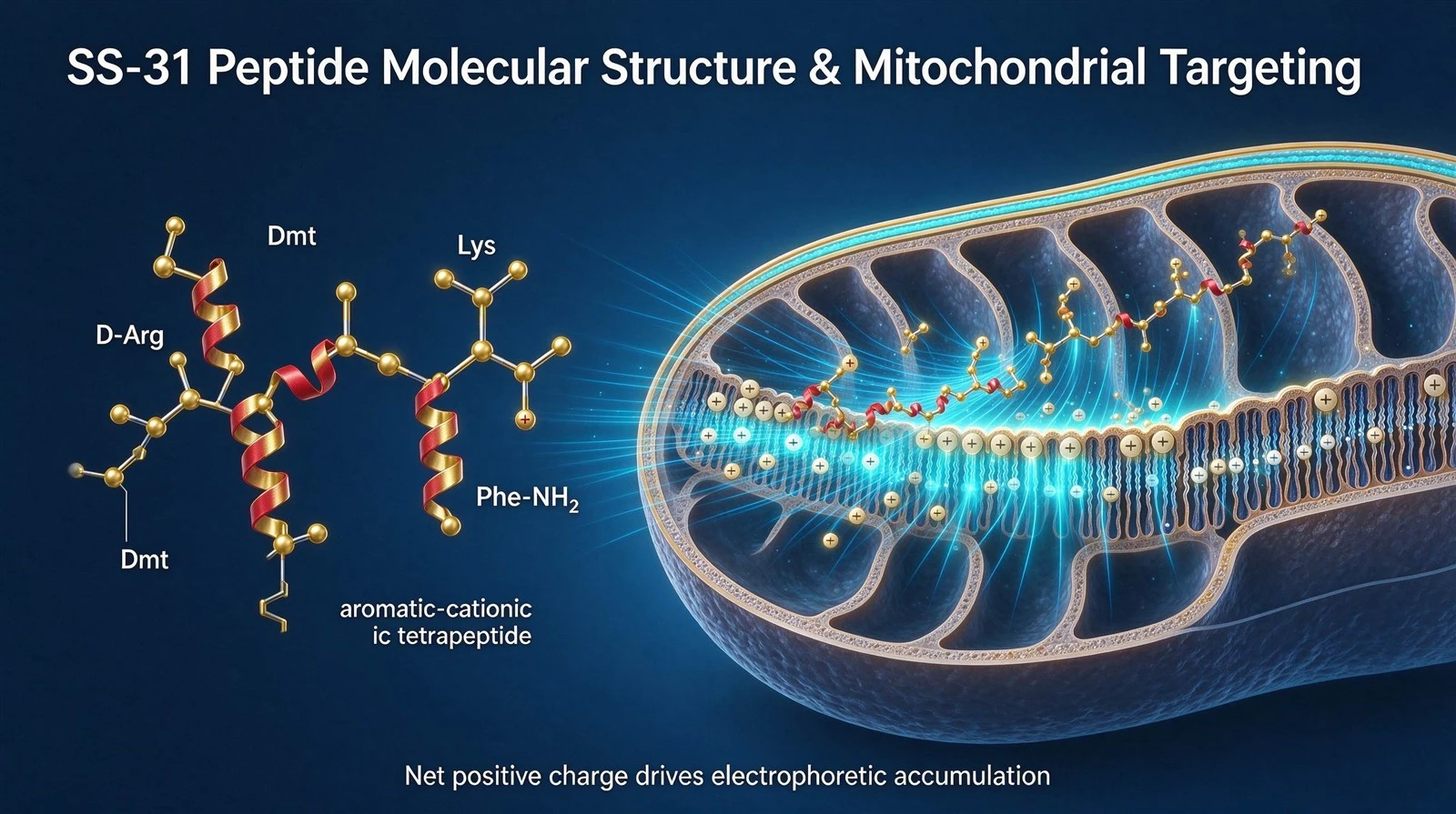
SS-31 Peptide Sequence and Molecular Properties
Core identity parameters for the free-base form of SS-31:
| Property | Value |
|---|---|
| Amino acid sequence | D-Arg-Dmt-Lys-Phe-NH₂ |
| Non-standard amino acid | Dmt = 2,6-dimethyltyrosine |
| Molecular formula | C₃₂H₄₉N₉O₅ (free base) |
| Molecular weight | ~639.8 g/mol (free base) |
| CAS number | 736992-21-5 |
| Peptide class | Aromatic-cationic tetrapeptide |
Note: Actual molecular weight, purity and assay may vary by salt form, counterion content, residual solvent and hydration. Always reference the supplier's Technical Data Sheet for the specific grade being supplied.
What Makes SS-31 a Mitochondria-Targeted Peptide?
SS-31 was designed to accumulate selectively in mitochondria, driven by two key structural features:
Net positive charge - The peptide carries a positive charge at physiological pH. The inner mitochondrial membrane maintains a large negative electrical potential relative to the cytosol, which drives electrophoretic accumulation of cationic molecules into the mitochondrial matrix.
Aromatic and hydrophobic residues - The Dmt and phenylalanine residues give the peptide aromatic and hydrophobic character, which supports insertion into and interaction with the hydrophobic core of the inner mitochondrial membrane.
Together, these properties cause SS-31 to concentrate several-hundred-fold in mitochondria relative to the extracellular environment, and to localize preferentially to the inner mitochondrial membrane.
Research Applications of SS-31
- SS-31 is used across a broad range of life science research areas:
- Mitochondrial membrane biology and biophysics
- Cardiolipin interaction and membrane organization studies
- Oxidative stress and cell survival research
- Ischemia-reperfusion injury models (cardiac, renal, cerebral)
- Skeletal muscle myopathy and aging studies
- Neurodegeneration and retinal disease models
- Mitochondrial bioenergetics and respiratory chain function studies
It is important to note that SS-31 is a research tool, not an approved therapeutic for general use.
SS-31 Research: What Is Known and What Remains Uncertain?
There is strong support from biophysical and cellular studies for a membrane-stabilizing mechanism of action. Effects on mitochondrial respiration, oxidative stress resistance and cell survival have been consistently reported across multiple laboratories.
At the same time, important uncertainties remain:
The relative contribution of different molecular mechanisms continues to be debated.
Efficacy in animal models does not consistently translate to human clinical benefit across all indications.
Optimal dosing, delivery and route of administration vary by model and application.
Long-term safety data across all populations remains limited.
For a deeper look at the proposed mechanism of action, see our full article on SS-31 mechanism of action.
FAQ
What is SS-31 peptide?
SS-31 is a synthetic aromatic-cationic tetrapeptide used as a mitochondria-targeted research tool in life science laboratories.
Is SS-31 also known as elamipretide?
Yes. SS-31 is the common research code name; elamipretide is the international nonproprietary name (INN) for the same molecule.
What is the amino acid sequence of SS-31?
The sequence is D-Arg-Dmt-Lys-Phe-NH₂, where Dmt stands for 2,6-dimethyltyrosine.
What is SS-31 studied for in research?
SS-31 is studied for mitochondrial membrane biology, cardiolipin interactions, oxidative stress resistance, and disease models including ischemia-reperfusion injury, myopathies and neurodegeneration.
How does SS-31 differ from other mitochondrial research peptides?
SS-31 is distinguished by its cardiolipin-targeted membrane-stabilizing mechanism. Other mitochondrial peptides may work through different mechanisms such as direct antioxidant activity or gene expression modulation.
Conclusion
SS-31 is a well-characterized mitochondria-targeted peptide with a broad range of research applications in mitochondrial biology. Its identity, sequence and mechanism have been extensively characterized in the preclinical literature.
For product specifications and sourcing information, visit the SS-31 Peptide Powder product page.
References
PubChem. Elamipretide. CID 11764719.
Szeto H.H. (2014). Mitochondria-targeted peptides: Pharmacophore development and therapeutic applications. Acc Chem Res. 47(7):2015-2023.
Sparvero L., et al. (2026). Cardiolipin remodelling in mitochondrial therapeutics: translational evidence chains from elamipretide to emerging strategies. Front Physiol. 17:1813119.